McAllistor Building
dangerousMcAllistor Building
The last known residence of missing artist Abigail Wright, and the location named in the self-written finale script back in Session 3 — before anyone had been hired to investigate it. Common areas entered Session 4; Abigail's unit (1A) not yet entered (police tape).
Known Details
- Owner: Art Life — a non-profit that rents space to artists at low cost (the Post instead calls it a co-op — unreconciled); bought the building from the Star Corporation in 1967 (Art Life Dossier)
- Manager: Cynthia Lechance
- Address: East 32nd Street, Kips Bay, Manhattan. (Gus's "23rd & 3rd Ave East" turned out to be the Art Life office, not the building — reconciled by the Art Life Dossier.)
Abigail's Apartment (1A) — Per the Case File
Not yet entered by the team (police tape; they hold freshly-cut keys). Per the Abigail Wright Case File, when police opened it on 4 SEP 2015 they found a tableau: every surface buried in junk epoxied to the walls — dentures, a 1940s wheelchair, antique prosthetic limbs, radios, jewelry, thousands of multilingual papers — with the floor bare and the rug torn up. A paper bearing a gold-ink occult symbol (the Rooftop Symbol) was in the debris. The Post notes the apartment was locked from the inside.
History (Art Life Dossier, Session 6)
The building began as the private residence of Henry M. Lundine (1886–1952) and was refitted into apartments via a permit addendum dated 2 MAR 1953, architect of record A. Darabondi. Three deaths/disappearances cluster around it:
| Person | Event | Date |
|---|---|---|
| Charles Lundine (owner's son, a musician) | hanged himself in the second-floor ballroom | 30 AUG 1950 |
| A. Darabondi (architect; suspected drowner of 5–20 children, 1947–1950) | disappeared | 1950 |
| Henry Lundine (owner) | found dead in the staircase to the roof, in silver robes and a white papier-mâché mask; ruled stroke | 30 APR 1952 |
Owned by the Star Corporation until 1967, then sold to Art Life.
The Building (visited Session 4)
A classic brownstone — two stories plus a basement by exterior read; the floorplan shows Ground / First / Second floors and a basement stair. Double doors, a concrete rampart, cheap gargoyles on the roof. A cornerstone dates construction to 1924. Buzzer lists Abigail Wright in 1A.
Entered Session 4 via a magnet on the door lock. Abigail Wright's door (1A) is under police tape, with a wired microphone in the rug outside it running to Thomas Manuel's apartment. Her mailbox held ~8 weeks of bills with the personal mail stripped out.
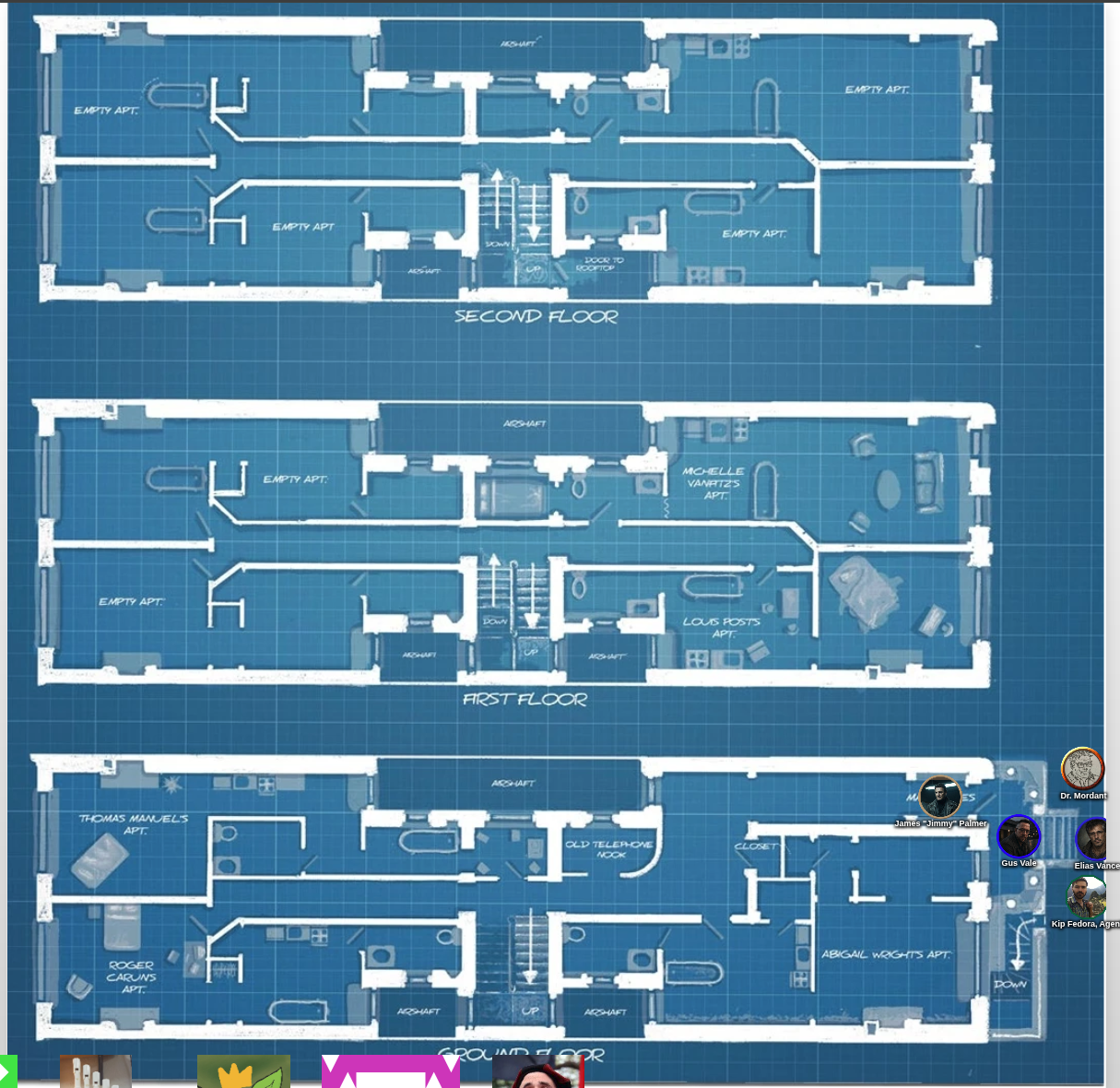
Residents by Floor
| Floor | Apartments |
|---|---|
| Ground | Thomas Manuel · Roger Carlins · Abigail Wright (1A) · old telephone nook · closet |
| First | Michelle Vanatz · Lewis Post ("Louis Posts Apt" on the plan) · two empty apts |
| Second | all empty · door to rooftop |
The Basement & the Night Floors
The basement holds a studio that Thomas Manuel paints in; access is granted by the night manager, Mr. Kasine (Session 4). Beyond the three real floors, the building has — per Abigail Wright's Night Floors Map — "night floors" reached from the empty second floor, with a parlor occupied by Mr. Ostanovic. In Session 5, tenants Lewis Post and Thomas Manuel describe a sixth-floor smoking lounge and a party there (see The Sixth-Floor Party) — the smoking lounge matching the impossible one beneath Box 13 HQ.
The Building Wakes (Session 5)
At 10:00 PM, mid-search, the building stopped feeling empty. The investigators heard multiple sets of footsteps beyond the apartment walls, a door opening and another closing elsewhere in the building, and creaking on the floor above them. After a day of near-total vacancy (an entirely empty second floor, no movement), the tenants are stirring — on multiple floors at once, including above the team. Status raised to dangerous.
Session 5 (next morning): by daylight the building is quiet again. The stirring appears to be a nocturnal cycle — active at night (the 10 PM footsteps, the talk of the sixth floor), dormant by day. The roof is likewise an ordinary roof by day; the team plans to return to the roof door at night to attempt entry to the night rooms.
Open Questions
- The building was named in a script that printed itself before the case existed. Why this building?
- What is Art Life, and why subsidize artists' rent?
- What woke the building at 10 PM — the tenants, the night floors, or the investigators' presence?